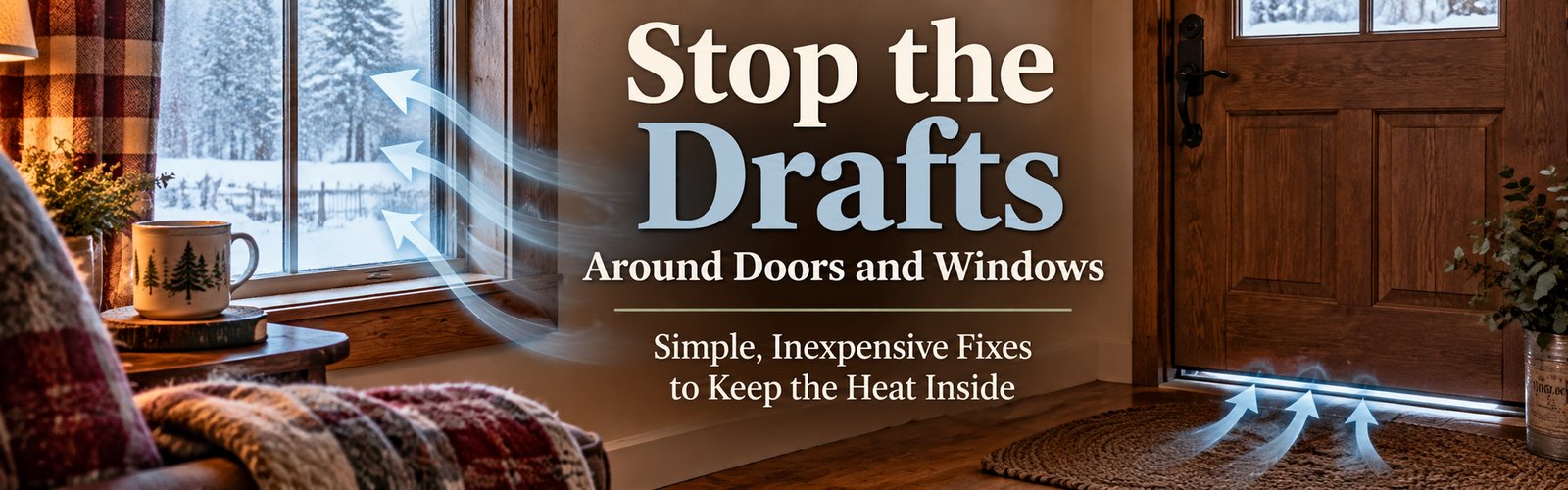
When cold weather arrives, a drafty house can become uncomfortable in a hurry. Even worse, all that warm air escaping through little cracks around doors and windows can mean higher heating bills.
The good news is that you don’t necessarily need new windows or expensive repairs.
Sometimes a few dollars’ worth of weatherstripping, caulk, or even a homemade draft stopper can make a noticeable difference.
Before spending a lot of money, find out where the cold air is getting in and fix the simplest things first.
Find the Draft Before You Fix It
On a cool or windy day, slowly run your hand around the edges of exterior doors and windows. Pay particular attention to:
- Around the door frame
- Along the bottom of exterior doors
- Where the window sash meets the frame
- Around window trim
- Around locks and latches
- Around electrical outlets and switches on exterior walls
You may be surprised how easy it is to feel cold air coming through a small opening.
You can also use a thin piece of tissue. Hold it near the suspected area and watch for movement.
Once you know where the air is coming from, you’ll have a much better idea of what needs fixing.
1. Replace Worn Weatherstripping
Weatherstripping is one of the cheapest ways to stop air from leaking around a door.
Look around the sides and top of an exterior door. If the existing weatherstripping is cracked, flattened, loose, or missing, it may no longer be doing its job.
Replacement weatherstripping is available in several types, including foam, rubber, and vinyl.
Before buying anything, measure the door and look carefully at what is already installed. You may be able to replace only the damaged section rather than everything.
Mountain Know-How Tip: Close the door on a piece of paper. If you can pull the paper out easily without much resistance, the seal may not be tight enough in that spot.
2. Stop the Draft Under the Door
If you can see daylight underneath an exterior door, you’ve probably found a significant source of heat loss.
A door sweep attaches to the bottom of the door and helps close that gap.
Before buying one, measure the width of the door and the size of the opening underneath it.
For an immediate temporary solution, a rolled towel placed along the bottom of the door can help.
You can also make a reusable draft stopper from an old towel, fabric, or even the leg of an old pair of pants. Fill it with scraps of fabric or another suitable filling and place it against the bottom of the door.
It doesn’t have to be pretty. It just has to stop the cold air.
3. Caulk Small Gaps Around Window and Door Frames
Sometimes the draft isn’t coming through the window itself. It’s coming from the small spaces around the frame or trim.
Look for visible cracks where the window or door trim meets the wall.
Small stationary gaps can often be sealed with caulk.
The important word here is stationary. Don’t caulk parts of a window or door that need to open, close, slide, or drain properly.
Clean away loose material and old deteriorated caulk before applying new caulk, and use a product intended for the location where you’re using it.
A small tube of caulk can sometimes fix several troublesome spots around the house.
4. Use Window Film for Especially Drafty Windows

Older windows can be difficult to seal completely.
If replacement windows aren’t in the budget—and they certainly aren’t inexpensive—clear plastic window insulation film can provide a temporary winter barrier.
The film is generally attached around the inside of the window and tightened according to the manufacturer’s directions.
It isn’t a permanent repair, but it can be useful for windows that aren’t normally opened during winter.
Come spring, it can be removed.
5. Check the Window Lock
Here’s one that costs nothing.
Make sure the window is completely closed and locked.
On many windows, engaging the lock pulls the two sections of the window together more tightly and improves the seal.
If a window doesn’t seem to close completely, check the track for dirt, debris, paint buildup, or anything else preventing it from seating properly.
Sometimes cleaning the track is all that’s needed.
6. Don’t Forget Outlets and Switches
If an electrical outlet or light switch is located on an exterior wall, you may occasionally feel cold air around it.
Foam outlet and switch gaskets are inexpensive and fit behind the cover plate to help reduce drafts.
However, don’t put loose insulation, fabric, paper, or other materials inside an electrical box.
If something about an outlet looks burned, damaged, loose, or otherwise unsafe, that’s no longer a draft problem—it’s an electrical problem that needs proper attention.
7. Close and Use Your Curtains
Sometimes the simplest things really do help.
Curtains, shades, and blinds can add another barrier between a cold window and the room.
Open curtains on sunny windows during the day and let the sun help warm the house.
Then close them when the sun goes down to help hold some of that warmth inside.
Just be careful that curtains aren’t touching heaters, heating vents, or other heat sources.
8. Check Doors You Rarely Use
That back door nobody uses all winter may be leaking cold air every single day.
If a seldom-used exterior door is particularly drafty, concentrate on sealing it well for the winter.
Weatherstripping, a door sweep, and a draft stopper together can make a considerable difference.
Don’t Assume You Need New Windows
A draft doesn’t automatically mean a window needs to be replaced.
Older windows may certainly become inefficient, but before spending thousands of dollars, check for the inexpensive problems first:
Is the window closing completely?
Is the weatherstripping worn out?
Is there a small crack around the frame?
Would temporary window film get you through the winter?
If a $10 or $20 repair solves the problem, there’s no reason to turn it into a $10,000 project.
Start With the Worst Draft
If money is tight, don’t feel as though you have to weatherproof the entire house at once.
Walk through the house and find the worst draft.
Fix that one.
Then find the next one.
A tube of caulk here, a piece of weatherstripping there, and a homemade draft stopper somewhere else may not seem like much individually. Together, they can make a home noticeably more comfortable.
And that’s really what Mountain Know-How is about:
Mountain Heart Ministries
Hope for Today • Help for Tomorrow • Faith for the Journey
Helping our Appalachian neighbors one life, one family,
and one community at a time.
Contact
info@mountainheartministries.org
Serving mountain communities in Eastern Kentucky
and Northeast Tennessee.
“My little children, let us not love in word, neither in tongue;
but in deed and in truth.”
1 John 3:18 (KJV)
© 2026 Mountain Heart Ministries. All Rights Reserved.
Mountain Heart Ministries is a Christian nonprofit organization
dedicated to serving individuals and families with compassion,
dignity, and hope.