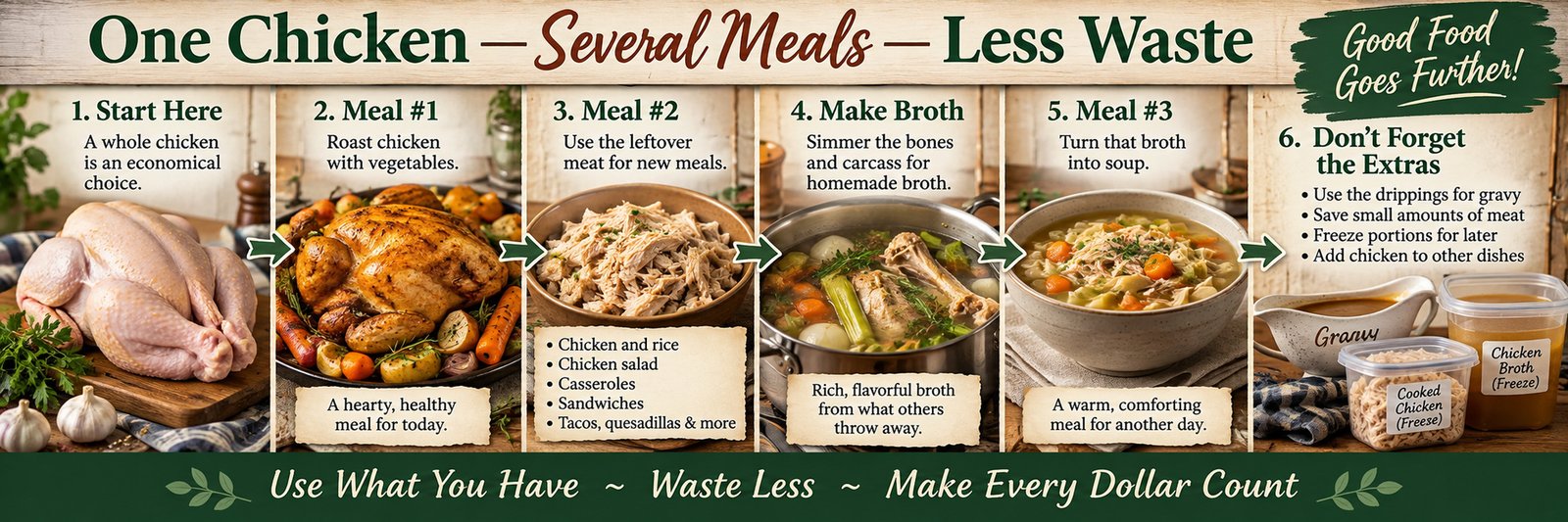
A whole chicken may not look like much of a bargain when you first see the price at the grocery store. But if you use all of it, that one chicken can provide several meals—and even the bones can be turned into something useful.
Our grandparents understood this. They didn’t cook a chicken, eat the best pieces, and throw the rest away. Food cost too much and took too much work to waste.
That same common sense makes just as much sense today.
The trick is to stop looking at a whole chicken as one supper.
Look at it as the beginning of several meals.
Start With the Whole Chicken
Whole chickens are often economical because you aren’t paying someone else to cut them into individual pieces.
Prices vary, so don’t assume a whole chicken is automatically the cheapest choice. Check the price per pound and watch for sales.
When you find a good price, buying an extra chicken for the freezer can make sense if your budget allows.
You don’t need a fancy recipe, either.
A little salt, pepper and whatever seasonings you already have can make a perfectly good roasted chicken.
Add potatoes, carrots or onions to the pan, and you’ve got supper cooking right alongside it.
Meal #1: Roast Chicken and Vegetables
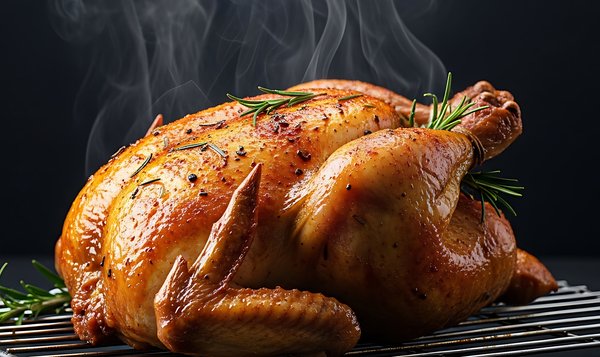
For the first meal, serve the chicken just as you normally would.
Add inexpensive sides such as:
- Potatoes
- Green beans
- Carrots
- Corn
- Rice
- Greens
- Homemade biscuits or cornbread
But here’s the important part:
Don’t put the whole chicken on the table and let everybody pick at it.
If you’re trying to stretch it, carve what you need for that meal and put the rest away.
A little planning tonight can become tomorrow’s supper.
Meal #2: Pick Every Bit of Meat From the Bones
Once the chicken has cooled enough to handle, remove the remaining meat.
And don’t just look for the big pieces.
There’s often quite a bit of good meat around the back, joints and other areas that gets overlooked.
Put the meat into a covered container and refrigerate it promptly.
Now you’ve got the beginning of another meal.
Depending on how much is left, that chicken can become:
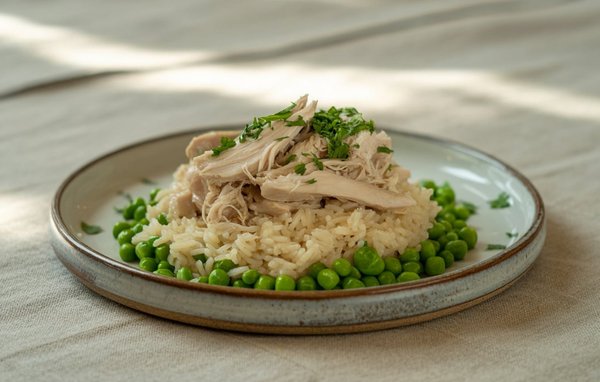
Chicken and rice
Mix chopped chicken with cooked rice, vegetables and a little broth.
Chicken sandwiches
Add lettuce, tomato or whatever you have.
Chicken salad
A little mayonnaise, chopped celery or onion can turn a small amount of chicken into several servings.
Chicken casserole
Combine chicken with noodles or rice, vegetables and a simple sauce.
Chicken tacos or quesadillas
A small amount of shredded chicken goes a surprisingly long way when combined with beans, cheese or vegetables.
Chicken and dumplings
Especially useful because the dumplings help stretch a relatively small amount of meat into a filling meal.
That’s one of the secrets to inexpensive cooking:
The meat doesn’t always have to be the biggest thing on the plate.
Don’t Throw Away the Bones
Now we’re getting to the part that many people throw in the garbage.
That chicken carcass still has something to give.
Put the bones and carcass into a large pot and cover them with water.
If you have them, add things such as:
- Onion
- Celery
- Carrot
- Garlic
- Pepper
- Herbs or seasonings
This is also a good place for clean vegetable trimmings you’ve deliberately saved for stock.
Bring everything to a boil, then reduce the heat and simmer gently until you’ve extracted plenty of flavor. Strain the liquid carefully and discard the solids.
Now you have homemade chicken broth.
Cool it promptly and refrigerate or freeze it safely if you aren’t using it right away.
Meal #3: Turn That Broth Into Soup
Homemade broth gives you the foundation for another inexpensive meal.
And soup is one of the best ways I know to make a little food feed more people.
Start with your broth and see what you already have.
Maybe there’s some chicken left.
Add potatoes, rice, noodles or barley.
Throw in carrots, corn, green beans, peas, celery or other vegetables.
A handful of this and a little of that can become a pot of soup.
Serve it with crackers, cornbread, biscuits or a piece of toast, and you’ve turned what might have gone into the garbage into another supper.
Meal #4: Stretch the Last of the Chicken
If you’ve still got a small amount of chicken left, don’t think:
“That’s not enough for another meal.”
Ask instead:
“What can I add to this?”
That’s an entirely different way of looking at leftovers.
Half a cup of chicken isn’t much if you’re serving chicken breasts.
But half a cup of chopped chicken can go into:
- A pot of soup
- Fried rice
- Chicken gravy over biscuits
- A baked potato topping
- A small casserole
- Chicken and noodles
- A quesadilla
- An omelet
- A pot pie
The chicken becomes one ingredient rather than the whole meal.
And that’s how you stretch it.
Don’t Forget the Drippings
If you roast your chicken, don’t automatically pour everything from the roasting pan down the drain.
Those drippings can contain a tremendous amount of flavor.
After separating excess fat as appropriate, the flavorful juices can be used to make gravy or added to soup or broth.
Even a small amount can make plain potatoes, rice or vegetables taste much better.
That’s another meal improved without buying anything else.
Cooking for One or Two? Freeze Some
A whole chicken can be especially useful for someone cooking for only one or two people—but eating chicken four nights in a row gets old pretty quickly.
You don’t have to.
Divide the leftover meat into small portions and freeze what you won’t use soon.
Label the package with what it is and the date.
Then, a few weeks later, you’ve already got cooked chicken waiting for soup, casserole or another quick meal.
You can do the same thing with your broth.
Freeze it in useful portions rather than one enormous container. Then you can thaw only what you need.
A Word About Food Safety
Stretching food is smart.
Keeping food too long isn’t.
Cook poultry thoroughly to a safe internal temperature, refrigerate leftovers promptly, and don’t leave cooked chicken sitting at room temperature for hours.
Use refrigerated leftovers within a safe period or freeze them.
If something smells wrong, looks questionable, or you aren’t sure how long it has been sitting in the refrigerator, saving a few dollars isn’t worth getting sick over.
Being frugal and being unsafe are two very different things.
What Could One Chicken Become?
Depending on the size of the chicken and the number of people you’re feeding, your results will vary.
But imagine this:
Sunday: Roast chicken, potatoes and green beans.
Monday: Chicken and rice with vegetables.
Tuesday: Homemade chicken soup made with broth from the bones.
Later: A frozen portion of chicken becomes chicken and noodles or a casserole.
That’s not bad for something that could easily have been treated as one meal.
Of course, a larger family may finish the chicken much faster. Someone living alone may get even more meals from it.
The exact number isn’t important.
The principle is.
Before You Throw Food Away, Look at It Again
Learning to stretch food isn’t about being stingy.
It’s about recognizing value.
The meat between the bones has value.
The carcass has value.
The broth has value.
The drippings have value.
And that little container of leftover chicken that doesn’t look like enough for supper still has value when you combine it with something else.
Don’t miss other helpful articles:
A Pot of Soup to Feed a Family
Mountain Heart Ministries
Hope for Today • Help for Tomorrow • Faith for the Journey
Helping our Appalachian neighbors one life, one family,
and one community at a time.
Contact
info@mountainheartministries.org
Serving mountain communities in Eastern Kentucky
and Northeast Tennessee.
“My little children, let us not love in word, neither in tongue;
but in deed and in truth.”
1 John 3:18 (KJV)
© 2026 Mountain Heart Ministries. All Rights Reserved.
Mountain Heart Ministries is a Christian nonprofit organization
dedicated to serving individuals and families with compassion,
dignity, and hope.