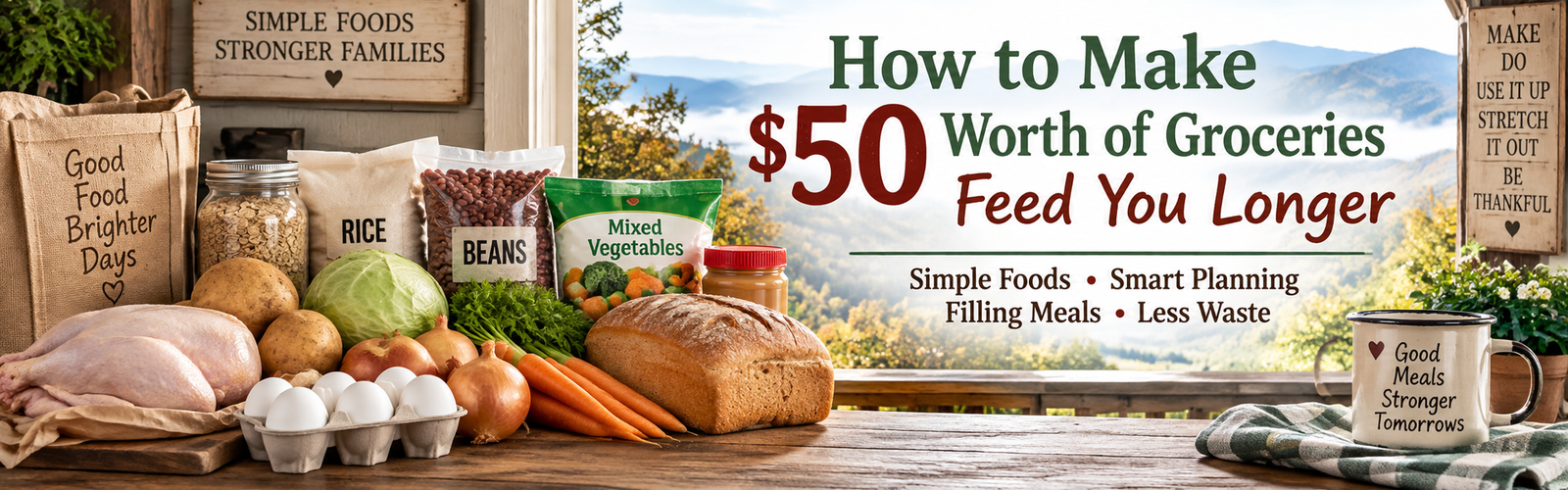
When grocery money is tight, the goal isn’t simply to buy the cheapest food you can find.
The real goal is to buy foods that can be turned into several filling meals without wasting anything.
A $50 grocery budget won’t buy what it did a few years ago, but careful choices can still stretch that money considerably. You don’t need fancy recipes, specialty ingredients, or a cart full of processed food.
You need basic foods that work together.
Mountain Know-How: Don’t shop for individual meals. Shop for ingredients you can use over and over again.
Start With Foods That Do More Than One Job
When every dollar counts, an ingredient that’s useful in four different meals is usually a better buy than something you’ll use only once.
Think about foods such as:
- Whole chicken or inexpensive chicken pieces
- Potatoes
- Rice
- Dry or canned beans
- Eggs
- Oatmeal
- Pasta
- Cabbage
- Carrots
- Onions
- Frozen vegetables
- Bread or tortillas
- Peanut butter
The exact prices will vary from store to store, so don’t worry about making your grocery list match someone else’s down to the penny.
Buy what’s inexpensive where you live.
A Sample $50 Grocery Basket
Here’s the kind of grocery basket I’d build. Prices vary too much to promise that every store will total exactly $50, so consider this a starting point rather than a strict shopping list.
| Food | Why It’s Worth Buying |
|---|---|
| Whole chicken | Several meals plus broth |
| 5-lb. bag of potatoes | Side dish, soup, breakfast or main dish |
| Rice | Cheap base for many meals |
| Beans | Filling source of protein |
| Eggs | Breakfast, lunch or dinner |
| Oatmeal | Inexpensive breakfasts |
| Cabbage | Keeps well and stretches meals |
| Carrots | Side dishes, soups and stews |
| Onions | Adds flavor to almost everything |
| Frozen mixed vegetables | No rush to use them before they spoil |
| Pasta | Quick, inexpensive meal base |
| Bread | Toast, sandwiches and other meals |
| Peanut butter | Filling breakfast, snack or sandwich |
If that exceeds your $50 budget at your store, don’t abandon the idea.
Adjust.
Maybe chicken is on sale but eggs aren’t. Perhaps you already have rice. Maybe potatoes are expensive this week but pasta is cheap.
Use the list as a framework—not a rule.
Start With the Chicken
A whole chicken is one of the best examples of making one purchase do several jobs.
Cook it once and don’t think of it as one supper.
Think:
Supper tonight + chicken for tomorrow + another meal + soup + broth.
The first meal might simply be roasted chicken, potatoes and carrots.
After supper, remove the remaining meat from the bones and refrigerate or freeze it promptly.
Now you’ve got cooked chicken ready for several more meals.
Meal #2: Chicken and Rice
You don’t need much chicken when you combine it with rice and vegetables.
Cook rice, add some chopped chicken and frozen vegetables, and season it with whatever you have.
One cup of leftover chicken can suddenly feed several people.
Meal #3: Chicken Soup
Put the chicken bones and carcass to work, too.
They can be used to make broth. Add carrots, onion, potatoes, rice, pasta or whatever vegetables you have available.
That last little bit of chicken that wasn’t enough for another dinner?
It’s plenty for soup.
And you’ve gotten another meal from something that might otherwise have gone into the trash.
Let Potatoes Do Some Heavy Lifting
Potatoes are one of the most useful foods to keep around because they can become so many different meals.
Use them:
- Baked
- Mashed
- Fried with onions
- Added to soup
- Roasted with chicken
- Mixed with eggs for breakfast
- Made into potato soup
A baked potato topped with leftover vegetables, beans, cheese if you have it, or a little chicken can become a meal instead of merely a side dish.
Beans and Rice Still Work
There’s a reason generations of families have eaten beans and rice when money was tight.
They’re inexpensive, filling and versatile.
Cook beans with onion and seasonings and serve them over rice.
The next day, those beans can go into soup, be mashed for a tortilla filling, or accompany potatoes.
You don’t have to eat exactly the same plate three days in a row just because you’re using the same ingredients.
Cabbage Is a Budget Workhorse
Cabbage doesn’t get nearly enough respect.
It’s usually inexpensive, keeps much longer than delicate salad greens, and a single head can go a long way.
Use it:
- Cooked with potatoes
- In soup
- Fried with onions
- As coleslaw
- Mixed into a stir-fry
- Added to beans
- Alongside chicken
If lettuce goes bad before you finish it, you’ve thrown away part of what you paid for.
A head of cabbage can often wait patiently in the refrigerator until you’re ready for it.
That’s part of saving money, too.
Breakfast Doesn’t Have to Come From a Box
Breakfast cereal can disappear surprisingly fast.
Oatmeal and eggs give you more options.
Oatmeal can be served with whatever you already have—cinnamon, raisins, apples, brown sugar, a little peanut butter or simply milk.
Eggs can become:
- Scrambled eggs and toast
- Egg sandwiches
- Fried potatoes and eggs
- Omelets using leftover vegetables
- Hard-boiled eggs
- Egg salad
And there’s nothing wrong with having eggs for supper.
The grocery police aren’t coming. 😂
Make Leftovers Into Ingredients
This may be the biggest trick of all.
Don’t look into the refrigerator and think:
“There’s not enough of that for another meal.”
Instead ask:
“What can I put it in?”
A small amount of chicken can go into soup.
Half an onion can go into beans.
A spoonful of vegetables can go into an omelet.
Leftover rice can become another meal.
A couple of potatoes can bulk up soup.
Stale bread can become toast, breadcrumbs, or part of another dish.
Those little bits are food you already paid for.
Use them.
Freeze It Before You Lose It
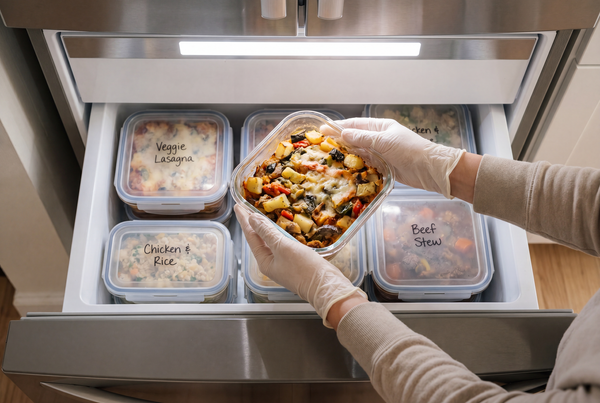
If you know you aren’t going to eat something before it spoils, freeze it while it’s still good.
Don’t wait until you find it three days later and say, “Well, I guess I’d better throw that out.”
Freeze leftover chicken in small portions.
Freeze bread.
Freeze cooked beans.
Freeze broth.
Freeze extra soup.
Even small amounts can be useful later.
A freezer full of little useful leftovers can eventually provide most of another meal.
Build Meals Around What You Already Have
Before going grocery shopping, look through:
the refrigerator, freezer, pantry and cabinets.
If you already have half a bag of rice, don’t buy another starch simply because it appears on a meal plan.
If there’s chicken in the freezer, use it.
If you have canned tomatoes, build a meal around them.
The cheapest grocery item is the one you’ve already paid for.
Watch the Price Per Pound
Big packages aren’t automatically cheaper.
Neither are warehouse-size quantities.
Look at the unit price when it’s available and compare.
And don’t buy a giant package simply because it costs less per ounce if part of it is likely to spoil before you use it.
Food thrown away isn’t a bargain at any price.
Don’t Spend Your Last Dollars on Convenience
When the budget is especially tight, convenience can get expensive.
Pre-cut vegetables, individual snack packages, single-serving oatmeal, prepared potatoes and ready-made meals may save time, but you’re often paying somebody else to do work you can do yourself.
There are certainly times when convenience foods make sense—particularly for someone who has difficulty standing, chopping or cooking.
But when you’re physically able and the primary goal is stretching money, compare the price.
Sometimes ten minutes in the kitchen saves several dollars.
What Could These Groceries Become?
With a basic basket of chicken, potatoes, rice, beans, eggs, oatmeal, vegetables, bread and a few pantry staples, you might make:
Breakfasts:
Oatmeal, eggs and toast, fried potatoes and eggs, peanut butter toast.
Lunches:
Chicken soup, peanut butter sandwiches, leftover beans and rice, baked potatoes.
Suppers:
Roasted chicken with potatoes and carrots, chicken and rice, beans and rice, pasta with vegetables, potato soup, chicken soup, cabbage and potatoes.
And the meals overlap.
That’s the secret.
One Last Rule: Don’t Waste What You Bought
Saving money at the grocery store doesn’t end when you leave the checkout line.
It ends when the food is eaten.
If $8 worth of a $50 grocery trip eventually goes into the trash, you didn’t really have a $50 food budget.
You had a $42 food budget and an $8 trash budget.
So use the leftovers. Freeze things before they spoil. Make soup from the odds and ends. Cook what’s getting old first. Stretch those groceries.
And remember:
You don’t have to eat fancy to eat well.
Sometimes the best meals are still the ones our grandparents understood perfectly well—simple food, cooked at home, with nothing wasted.
Mountain Heart Ministries
Hope for Today • Help for Tomorrow • Faith for the Journey
Helping our Appalachian neighbors one life, one family,
and one community at a time.
Contact
info@mountainheartministries.org
Serving mountain communities in Eastern Kentucky
and Northeast Tennessee.
“My little children, let us not love in word, neither in tongue;
but in deed and in truth.”
1 John 3:18 (KJV)
© 2026 Mountain Heart Ministries. All Rights Reserved.
Mountain Heart Ministries is a Christian nonprofit organization
dedicated to serving individuals and families with compassion,
dignity, and hope.