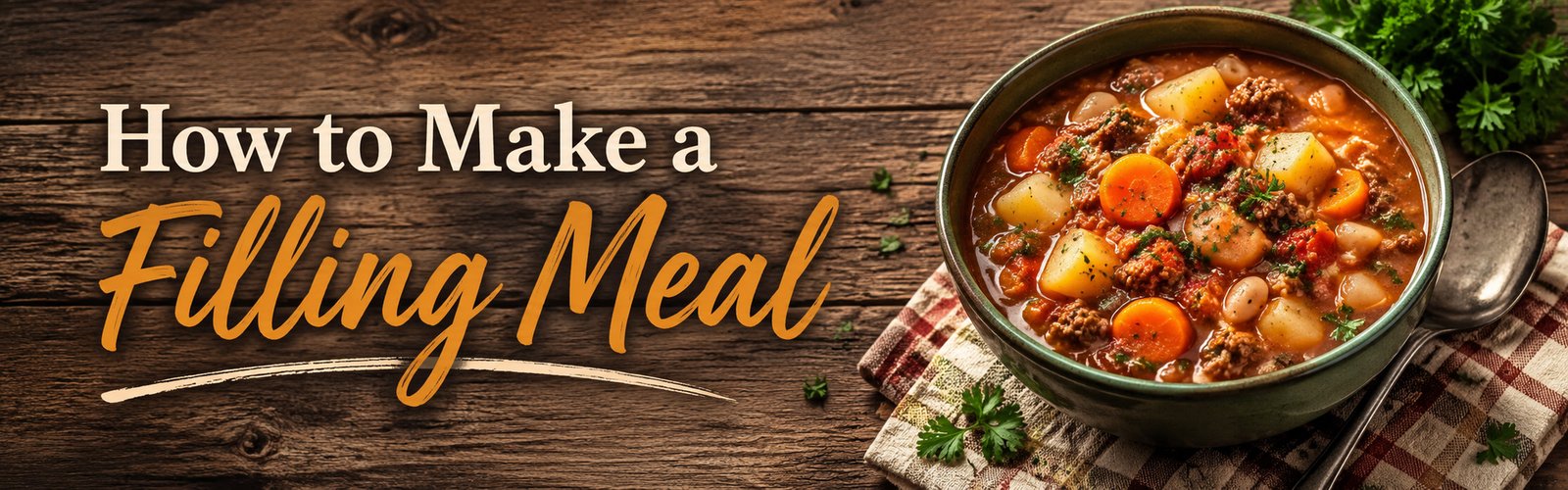
There are nights when you look in the refrigerator and think:
“There isn’t enough here to make supper.”
Usually, there is.
The trick is knowing how to turn a little of this and a little of that into something that will fill everybody up.
Our mothers and grandmothers were masters at this. A small piece of meat didn’t have to feed everybody by itself. It flavored a pot of beans. Leftover vegetables didn’t get thrown away because there wasn’t enough for another serving. They went into soup.
It wasn’t fancy cooking.
It was knowing how to make the most of what you had.
Start With Something Filling
When food is short, begin with an inexpensive food that fills the stomach.
Some of the best are:
- Potatoes
- Rice
- Beans
- Pasta
- Oatmeal
- Cornmeal
- Flour
- Eggs
Then look around the kitchen and see what you can add.
A cup of leftover chicken isn’t much if you’re trying to put a chicken breast on everyone’s plate.
But chop that same chicken and add it to rice with a little broth and some vegetables, and suddenly you’re getting somewhere.
The question changes from:
“Do I have enough chicken?”
to:
“What can I make with the chicken I have?”
That’s an entirely different way of looking at the kitchen.
Make Meat the Flavor Instead of the Meal
We have become accustomed to building meals around a large serving of meat.
It doesn’t always have to be that way.
A relatively small amount of meat can add plenty of flavor to:
- Beans
- Soup
- Stew
- Rice
- Pasta
- Casseroles
- Potatoes
- Gravy
- Eggs
A little ham can season a whole pot of beans.
A small amount of sausage can make sausage gravy for biscuits.
A pound of ground beef can go much farther when combined with beans, tomatoes, rice or pasta than it will as four hamburgers.
Instead of asking how many servings of meat you have, ask how many servings of supper you can make from it.
Beans Are One of the Best Foods for Stretching a Meal
Beans are inexpensive, filling and useful in dozens of meals.
Keep dried or canned beans around when you can.
They can become:
- Pinto beans and cornbread
- Bean soup
- Chili
- Beans and rice
- Burritos
- Taco filling
- White beans with ham
- Vegetable and bean soup
Beans can also stretch ground beef.
If you normally use a pound of beef in chili, try using less meat and more beans.
The family may barely notice.
Your grocery budget will.
Never Underestimate a Potato
Potatoes have fed a lot of hungry families for a reason.
They’re filling, inexpensive and can become almost anything.
You can:
- Bake them
- Mash them
- Fry them
- Roast them
- Add them to soup
- Make potato soup
- Make hash
- Turn leftover mashed potatoes into potato cakes
A baked potato can also become the base of an entire meal.
Top it with leftover chili, beans, cheese, vegetables, taco filling or whatever else needs to be used.
Suddenly, a small amount of leftover food becomes supper.
Eggs Aren’t Just for Breakfast
When money is tight, forget the idea that certain foods belong only at certain times of day.
Eggs make a perfectly good supper.
Add potatoes, toast, biscuits, grits or whatever you have available.
An omelet is also one of the easiest ways to use small amounts of leftovers.
A little cheese.
Half an onion.
A few mushrooms.
A spoonful of leftover ham.
Some peppers.
None of those amounts may look like much on their own.
Put them into eggs and you’ve made a meal.
Learn to Make Soup From Almost Nothing
Soup may be the greatest food stretcher ever invented.
Start with broth, stock, bouillon or simply water that you season well.
Then look through the refrigerator.
You might find:
- Half an onion
- One carrot
- A little celery
- Leftover green beans
- A cup of corn
- A small piece of chicken
- Leftover rice
- A few potatoes
- Beans
- Tomatoes
Individually, those leftovers don’t amount to much.
Together, they can become a pot of soup.
Add rice, pasta, beans, potatoes or dumplings if the soup needs more substance.
Serve it with bread or cornbread and you’ve turned odds and ends into dinner.
Save the Little Leftovers
This requires changing one habit.
Don’t automatically throw away a small amount of food because it isn’t enough for another meal.
Half a cup of corn isn’t a side dish for a family.
But it is an ingredient.
So is a little leftover rice.
So are two spoonfuls of peas.
So is the small piece of roast nobody ate.
Keep a designated freezer container or small freezer bags for useful leftovers if you won’t use them within a few days.
Label them so you know what’s inside.
Those little bits can eventually become soup, stew, casserole, fried rice or another meal.
Of course, use good food-safety practices. Refrigerate leftovers promptly and don’t save food that has sat out too long or is questionable.
Saving food is smart.
Saving spoiled food isn’t.
Learn a Few Basic Things to Make From Flour and Cornmeal
You don’t have to become an expert baker.
But knowing how to make a few simple foods from inexpensive staples can turn a sparse meal into a filling one.
Think about:
- Biscuits
- Cornbread
- Dumplings
- Pancakes
- Simple muffins
- Basic bread
A bowl of soup may not seem like quite enough.
Add warm cornbread and it becomes supper.
A little sausage won’t feed a family.
Turn it into gravy and make biscuits, and it can go considerably farther.
These are basic kitchen skills that are worth knowing.
Gravy Can Stretch Flavor
Gravy was never meant to be glamorous.
It was meant to be good.
A little meat drippings, flour and milk or broth can create something that makes biscuits, potatoes, rice or meat more satisfying.
Sausage gravy is an obvious example.
A relatively small amount of sausage can flavor enough gravy for several people when served over homemade or inexpensive biscuits.
That’s very different from trying to serve everyone several sausage patties.
Same food.
Different thinking.
Fried Rice Is Made for Leftovers
Have leftover cooked rice?
You’re halfway to another meal.
Add whatever you have:
- Egg
- Onion
- Peas
- Carrots
- Leftover chicken
- Pork
- Other vegetables
You don’t need every ingredient found in a restaurant version.
The whole point is using what you already have.
One important food-safety note: cooked rice should be refrigerated promptly after a meal and kept cold until you’re ready to use it. Don’t leave cooked rice sitting at room temperature for hours.
Cook Once and Plan for the Second Meal
Leftovers become much more appealing when the second meal isn’t simply a repeat of the first.
Suppose you cook a larger roast or chicken when you find one at a good price.
Meal one might be roast with potatoes and vegetables.
The remaining meat might become:
Meal two: sandwiches or wraps.
Meal three: soup, stew, casserole or pot pie.
The bones from a chicken can even be used to make broth before they’re discarded.
That’s not eating leftovers for three days.
That’s using one cooking job to help make several different meals.
Keep a “Lean Week” Pantry
When possible, keep a few inexpensive staples on hand for the week when money runs short or you simply can’t get to the grocery store.
You don’t need a giant emergency pantry.
Start with foods your family actually eats.
A useful basic supply might include:
- Rice
- Dried or canned beans
- Pasta
- Canned tomatoes
- Potatoes
- Oatmeal
- Flour
- Cornmeal
- Peanut butter
- Canned or shelf-stable meat when affordable
- Bouillon or broth
- A few canned or frozen vegetables
- Basic seasonings
If you have those foods plus a few things in the refrigerator, you can usually put something together.
Build the supply gradually.
Buy one extra bag of rice when you can.
One extra can of beans.
One extra package of pasta.
You don’t have to fill the pantry in one shopping trip.
Before Going to the Store, Shop Your Kitchen
This is one of the easiest ways to save money.
Before deciding there’s “nothing to eat,” look everywhere.
Check:
The refrigerator.
The freezer.
The pantry.
Then look again.
What’s hiding behind the milk?
What’s in that freezer container?
Is there half a bag of potatoes?
Three eggs?
A can of tomatoes?
Some rice?
A little leftover chicken?
Now ask:
What can I make from these things?
Sometimes buying one missing ingredient can turn what you already own into several meals.
That’s much cheaper than buying an entirely new meal while perfectly usable food sits at home.
Supper Doesn’t Have to Look Like a Picture
This may be the most important part.
A meal doesn’t have to contain a meat, two vegetables, bread and dessert to qualify as supper.
Some nights supper is beans and cornbread.
Some nights it’s potato soup.
Sometimes it’s scrambled eggs and biscuits.
Sometimes it’s a big pot of vegetable soup made from everything that needed to be eaten.
And sometimes everybody gets a baked potato and chooses from whatever toppings you managed to find in the refrigerator.
If everyone leaves the table satisfied, you made supper.
That’s what counts.
Mountain Heart Ministries
Hope for Today • Help for Tomorrow • Faith for the Journey
Helping our Appalachian neighbors one life, one family,
and one community at a time.
Contact
info@mountainheartministries.org
Serving mountain communities in Eastern Kentucky
and Northeast Tennessee.
“My little children, let us not love in word, neither in tongue;
but in deed and in truth.”
1 John 3:18 (KJV)
© 2026 Mountain Heart Ministries. All Rights Reserved.
Mountain Heart Ministries is a Christian nonprofit organization
dedicated to serving individuals and families with compassion,
dignity, and hope.