You flush the toilet.
It fills up.
Everything gets quiet.
Then a few minutes later you hear it:
ssssssssss…
The toilet is filling again even though nobody has used it.
A running toilet is annoying, but it can also waste a surprising amount of water. Before calling a plumber, take the lid off the tank and have a look.
A toilet isn’t nearly as complicated as it appears.
In many cases, the problem is a worn flapper, an improperly adjusted chain, or a water level that needs adjusting.
And sometimes the repair doesn’t cost anything at all.
First: Take the Tank Lid Off
Carefully remove the lid from the toilet tank and put it somewhere safe.
Don’t lean it against the bathtub or balance it on the toilet seat. Those porcelain lids are heavy, breakable, and surprisingly expensive to replace.
Now flush the toilet while watching what happens inside the tank.
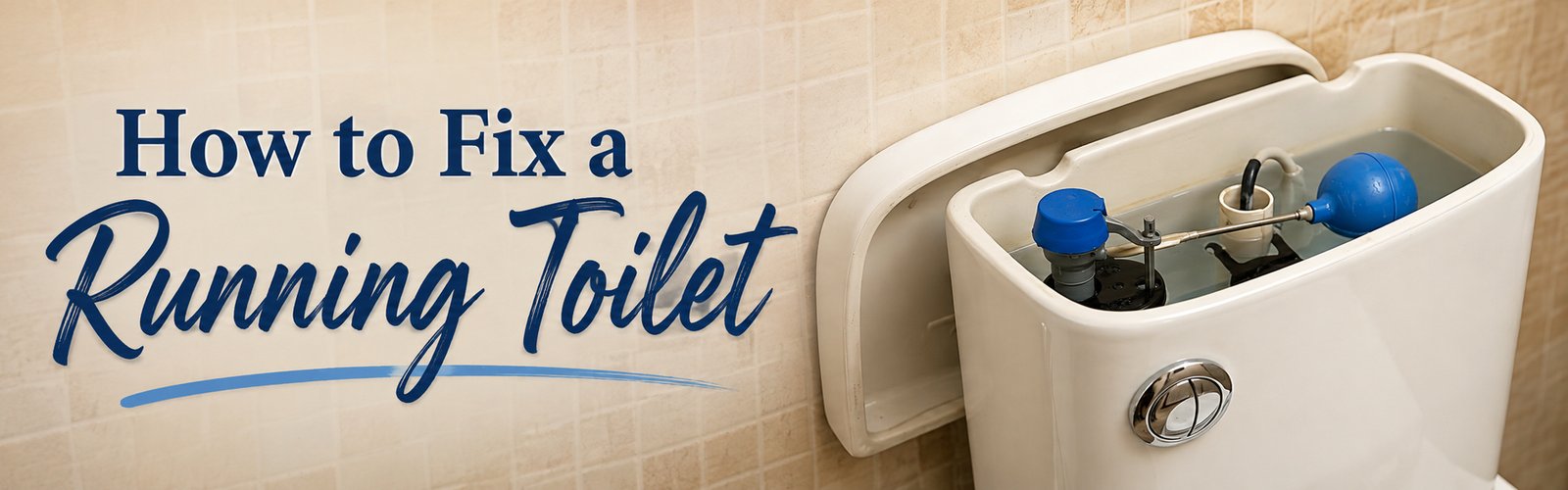
You’ll see several basic parts:
- The flapper at the bottom of the tank
- A chain connecting the flush handle to the flapper
- The fill valve, usually standing vertically on one side
- A float that controls the water level
- The overflow tube, an open vertical tube near the center
Once you understand what these few pieces do, troubleshooting gets much easier.
The Most Common Problem: The Flapper
The flapper is the rubber piece covering the opening at the bottom of the tank.
When you push the toilet handle, the chain lifts the flapper.
Water rushes from the tank into the bowl.
Then the flapper drops back down and seals the opening so the tank can refill.
At least, that’s what is supposed to happen.
Over time, the rubber can become stiff, warped, cracked or coated with mineral deposits.
Then it doesn’t seal completely.
A small amount of water continually leaks from the tank into the bowl. As the tank level drops, the fill valve turns on and replaces the lost water.
That’s the mysterious toilet that keeps turning itself on.
Try the Food-Coloring Test
Here’s an easy way to find out whether the flapper is leaking.
Put several drops of food coloring into the toilet tank.
Don’t flush.
Wait about 15–30 minutes.
Then look in the toilet bowl.
If colored water has appeared in the bowl, water is leaking from the tank even though you haven’t flushed.
The flapper or its sealing surface is a likely culprit.
Don’t Buy a New Flapper Yet
Before replacing anything, look closely at the existing flapper.
Sometimes:
- The chain is caught underneath it.
- The flapper isn’t sitting squarely over the opening.
- Mineral deposits or debris are preventing a good seal.
- The chain is pulling slightly on the flapper even when the toilet isn’t being used.
Correct the obvious problem and see whether the leak stops.
Your repair bill may be exactly $0.
Check the Chain
The chain needs a little slack when the flapper is closed.
If it’s too tight, it may hold the flapper slightly open.
If it’s much too loose, it can become tangled or fail to lift the flapper properly.
Adjust where the chain connects to the flush lever so there’s a small amount of slack when the flapper is closed.
Then flush the toilet several times.
Make sure the flapper opens fully and drops back into place without the chain getting underneath it.
Sometimes that’s all the repair requires.
If the Flapper Is Worn Out
If the flapper is cracked, stiff, warped or simply won’t seal anymore, replacing it is usually a straightforward job.
First, turn off the toilet’s water supply.
Look behind or beside the toilet near the floor. You should see a small shutoff valve where the water line comes out of the wall or floor.
Turn it clockwise until the water is off.
Flush the toilet to empty most of the water from the tank.
Remove the old flapper from its mounting points and disconnect the chain.
Take the old flapper with you when buying the replacement if possible.
That makes it easier to find one that fits your toilet.
Install the new flapper according to its instructions, reconnect the chain, turn the water back on and test the toilet.
What If Water Is Running Into the Overflow Tube?
Watch the water level as the tank fills.
Normally, the water should stop below the top of the overflow tube.
If the water keeps rising until it spills into that tube, the flapper probably isn’t your problem.
The toilet is simply filling too high.
That points toward the float or fill valve.
Check the Float
The float tells the fill valve when enough water has entered the tank.
Older toilets may have a large ball attached to a metal arm.
Newer toilets often have a float that moves up and down along the fill valve.
If the float is adjusted too high, the toilet may continue filling until water enters the overflow tube.
Many newer fill valves have a screw, clip or adjustment mechanism that lets you lower the water level.
Make a small adjustment.
Flush.
Let the tank refill.
Then check the water level again.
You don’t need to make huge changes.
A little adjustment may solve the problem.
The Fill Valve May Be the Problem
If the float is adjusted correctly but the water still won’t shut off properly, the fill valve itself may be worn.
A fill valve is the mechanism that lets fresh water into the tank after you flush.
They don’t last forever.
Before replacing one, make sure the float moves freely and nothing is preventing it from shutting the valve off.
If the valve still won’t behave, replacement fill valves are readily available at hardware and home-improvement stores.
Replacing one is within the ability of many homeowners, but it involves disconnecting the toilet’s water-supply connection.
If you’re uncomfortable doing that, this may be the point where calling someone makes sense.
What If the Toilet Handle Is the Problem?
Sometimes the trouble isn’t deep inside the toilet at all.
Try the handle.
Does it feel loose?
Does it stick?
Does it stay partially down after flushing?
A sticking handle can keep tension on the chain, which keeps the flapper from closing completely.
Look inside the tank while operating the handle.
You may immediately see what’s happening.
Sometimes tightening, repositioning or replacing the inexpensive handle assembly solves the whole problem.
When to Stop and Call a Plumber
Not every toilet problem is a five-dollar repair.
Call for help if:
- Water is leaking around the base of the toilet.
- The toilet itself is cracked.
- The shutoff valve leaks or won’t operate.
- The toilet repeatedly clogs despite normal use.
- Water backs up into other drains.
- The toilet rocks or moves at the floor.
- You can’t identify where the water is going.
- The repair requires work you’re simply not comfortable doing.
There is no prize for turning a small plumbing problem into a flooded bathroom.
Knowing what not to repair yourself is part of good home maintenance too.
Fix the Simple Things First
A running toilet sounds like a plumbing problem.
And technically, it is.
But that doesn’t automatically mean you need a plumber.
Take off the tank lid.
Watch what happens.
Check the flapper.
Check the chain.
Check the water level.
Check the float.
A five-minute inspection may tell you exactly what’s wrong.
That’s what Fix & Repair is about.
Understand the problem before spending money on the solution.
Sometimes you really do need a professional.
And sometimes you just need a new flapper.
Enjoy these helpful articles:
Mountain Heart Ministries
Hope for Today • Help for Tomorrow • Faith for the Journey
Helping our Appalachian neighbors one life, one family,
and one community at a time.
Contact
info@mountainheartministries.org
Serving mountain communities in Eastern Kentucky
and Northeast Tennessee.
“My little children, let us not love in word, neither in tongue;
but in deed and in truth.”
1 John 3:18 (KJV)
© 2026 Mountain Heart Ministries. All Rights Reserved.
Mountain Heart Ministries is a Christian nonprofit organization
dedicated to serving individuals and families with compassion,
dignity, and hope.