Shop Your House First
We do something almost automatically these days.
We need something.
We think about where to buy it.
Maybe we check Amazon. Maybe Walmart. Maybe we start looking for the cheapest price.
But there’s a question we ought to ask before we start shopping:
What do I already have that could do the job?
Notice that’s a little different from asking whether you already own the exact thing you need.
You may not.
But somewhere in your house, garage, basement, shed, pantry or junk drawer may be something else that will solve the problem just as well.
Saving money isn’t always about finding a better price.
Sometimes it’s about finding a solution that doesn’t require buying anything at all.
Look Around Before You Shop
This is one of those habits that used to come naturally.
When something was needed, people looked around.
They improvised.
They adapted.
They figured out what they could use.
We’ve gotten away from that because it’s so easy to buy exactly what we think we need. A few clicks and it can be sitting on the front porch tomorrow.
So try something different.
When you catch yourself saying:
“I need to buy…”
stop before finishing the sentence.
Take a look around.
Ask:
What am I actually trying to accomplish?
Then:
Do I have anything here that could accomplish it?
That’s the important part.
You aren’t necessarily looking for the thing you thought you needed.
You’re looking for something that will do the job.
The Answer May Already Be Within Reach
Suppose you need something to raise a plant off the floor.
You could buy a plant stand.
But perhaps there’s a little stool in the garage that nobody uses.
Need a container for screws?
You could buy a plastic organizer.
Or there may be an empty coffee can or jar sitting ten feet away.
Need something to protect the floor while you’re painting?
You could buy a drop cloth.
Or perhaps you have an old sheet that hasn’t been used in years.
Need a small table beside a chair?
Before shopping for one, look through the other rooms. There may be something you can move.
The point isn’t to surround yourself with makeshift junk.
It’s simply to recognize that the solution to a problem doesn’t always have to be the product designed and marketed for that problem.
Sometimes the answer is already sitting right in front of you.
Take a Lap Around the House
Before buying something for the house, literally take a look around.
Check:
- The garage
- The basement
- The shed
- Closets
- Cabinets
- The pantry
- The laundry room
- The junk drawer
- Leftovers from previous projects
Don’t look only for the exact item on your shopping list.
Look for possibilities.
Could something be moved?
Could something be cut down?
Could it be painted?
Could it be cleaned up?
Could you use part of it?
Could it serve a different purpose?
Could you repair the thing you already have?
Could two things you already own solve the problem together?
That’s where the real savings begin.
Shop Your Pantry Before the Grocery Store
The same principle works with food.
Before making your grocery list, look at what you already have.
Really look.
Check the pantry.
Then the refrigerator.
Then the freezer.
You may discover enough food for several meals that you’d forgotten about.
That package of chicken in the freezer.
Half a bag of rice.
Three cans of beans.
Some frozen vegetables.
A box of pasta.
Potatoes that need to be used.
Instead of asking:
“What do I want to cook this week?”
try asking:
“What meals can I make from what I already have?”
Then buy whatever is needed to fill the gaps.
You aren’t merely using up food.
You’re solving the problem of what to feed everybody with resources you already own.
Look Under the Sink Before Buying Another Cleaner
Need something to clean a particular mess?
Before buying another specialized bottle, look at what you already have.
There may already be a perfectly suitable product under the sink.
And many ordinary cleaning jobs don’t require a separate product made specifically for that one purpose.
Sometimes dish soap, a scrub brush, an old toothbrush or another basic item you already own will do the job perfectly well.
One caution: never mix household cleaning chemicals unless you know the combination is safe. In particular, never mix bleach with ammonia, vinegar or other acids.
Saving a few dollars isn’t worth creating dangerous fumes.
Check the Garage Before the Hardware Store
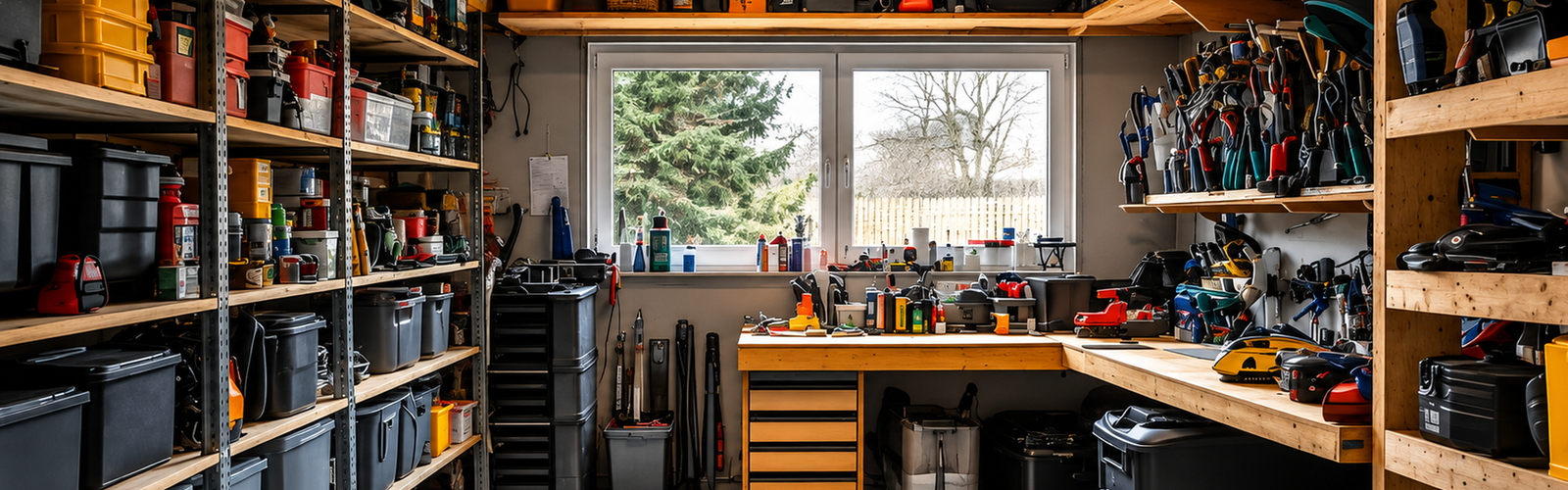
This may be my favorite place to “shop.”
Need two screws?
A little piece of wood?
A bracket?
Some wire?
A paintbrush?
A length of hose?
A container?
Before driving to the hardware store, look around the garage or workshop.
Don’t just glance.
Dig a little.
If you’ve lived in the same house for any length of time, there’s a fair chance that something left over from an old project can solve today’s problem.
Save useful screws, bolts, washers, brackets and other hardware in small containers where you can find them.
Today’s leftover part may be tomorrow’s free repair.
Repair What You Have
Sometimes the solution isn’t finding another object.
It’s making the one you already own work again.
Before replacing something, ask:
What exactly is wrong with it?
A chair may need glue.
A cabinet door may need its screws tightened.
A lamp may need a new switch.
A shirt may need one button.
A drawer may need its track adjusted.
A garden tool may simply need sharpening.
We sometimes replace an entire item because one small part has failed.
Take a few minutes to investigate before buying the replacement.
Shop Your Closet
Clothing is another place where we forget what we already have.
Things migrate to the back of the closet.
Then we buy something remarkably similar.
Before shopping, take a look.
And if you need something for a particular purpose, don’t necessarily look for the exact garment you imagined.
Could something you already own work?
Could it be:
- Mended
- Hemmed
- Altered
- Cleaned
- Stain-treated
- Worn differently
- Used for another purpose
An old T-shirt may no longer be something you’d wear into town.
That doesn’t make it useless.
It may have years of life left as a work shirt or cleaning rag.
Use the whole life of the item.
Move Things From One Room to Another
Sometimes we think we need something new because we’ve stopped seeing what we already own.
That little table in the bedroom may be exactly what you need beside a living-room chair.
A basket from the bathroom may solve a storage problem in the kitchen.
A lamp that doesn’t work visually in one room may be perfect in another.
Before buying something for a room, walk through the rest of the house.
Look at your belongings as resources, rather than objects permanently assigned to one place.
Moving something costs nothing.
Repurpose Before You Purchase
A lot of useful household items begin life as something else.
Glass jars can hold dry goods, buttons or screws.
Coffee cans can store small tools.
Old towels can become cleaning cloths.
Cardboard boxes can organize closets.
Plastic containers can hold small household items.
An old dresser can provide storage in a garage or workshop.
You don’t have to save everything.
That’s how you eventually end up needing another garage just to hold all the things you’re saving. 😂
The idea isn’t to become a pack rat.
It’s to look at something before throwing it away and ask:
“Do I currently have a use for this?”
If not, let it go.
If you do, you’ve just solved a problem without buying something else.
Borrow What You Don’t Need to Own
Sometimes you really do need a particular thing and there’s no substitute in the house.
You still may not need to buy it.
If it’s something you’ll use once every five years, ask whether you can borrow one.
A family member, neighbor or friend may have exactly what you need.
Next month, you may have something they need.
People did this for generations.
Every household doesn’t have to own every tool ever invented.
Borrow it.
Take care of it.
Return it promptly.
Don’t Let “It’s Only $10” Fool You
Here’s where small purchases sneak into the budget.
“It’s only $5.”
“It’s only $10.”
“It’s only $15.”
The amount isn’t really the point.
The question is whether you needed to spend it at all.
Five unnecessary $10 purchases are $50.
Ten are $100.
The better question isn’t:
“Can I afford $10?”
It’s:
“Can I solve this without spending the $10?”
Try the Look-Around-First Rule
You don’t really need a complicated money-saving challenge.
Just make one rule:
Before buying a nonessential item, look around first.
Ask yourself:
Do I already own it?
Can something else I own do the job?
Can I repair what I have?
Can I modify or repurpose something?
Can I borrow it?
If none of those works and you genuinely need the item, buy it.
This isn’t about going without.
It’s about giving yourself a chance to find another solution before money becomes the solution.
The Cheapest Price Isn’t Always the Biggest Savings
We spend a lot of time trying to save money by shopping.
We compare prices.
Clip coupons.
Wait for sales.
Search for discount codes.
And there’s nothing wrong with any of that.
But sometimes we’re concentrating on saving 20 percent on something when we could save 100 percent by not buying it.
A $20 item marked down to $15 didn’t save you $5 if something sitting in your garage would have done the same job.
You spent $15.
The real savings was sitting in the garage.
Mountain Heart Ministries
Hope for Today • Help for Tomorrow • Faith for the Journey
Helping our Appalachian neighbors one life, one family,
and one community at a time.
Contact
info@mountainheartministries.org
Serving mountain communities in Eastern Kentucky
and Northeast Tennessee.
“My little children, let us not love in word, neither in tongue;
but in deed and in truth.”
1 John 3:18 (KJV)
© 2026 Mountain Heart Ministries. All Rights Reserved.
Mountain Heart Ministries is a Christian nonprofit organization
dedicated to serving individuals and families with compassion,
dignity, and hope.