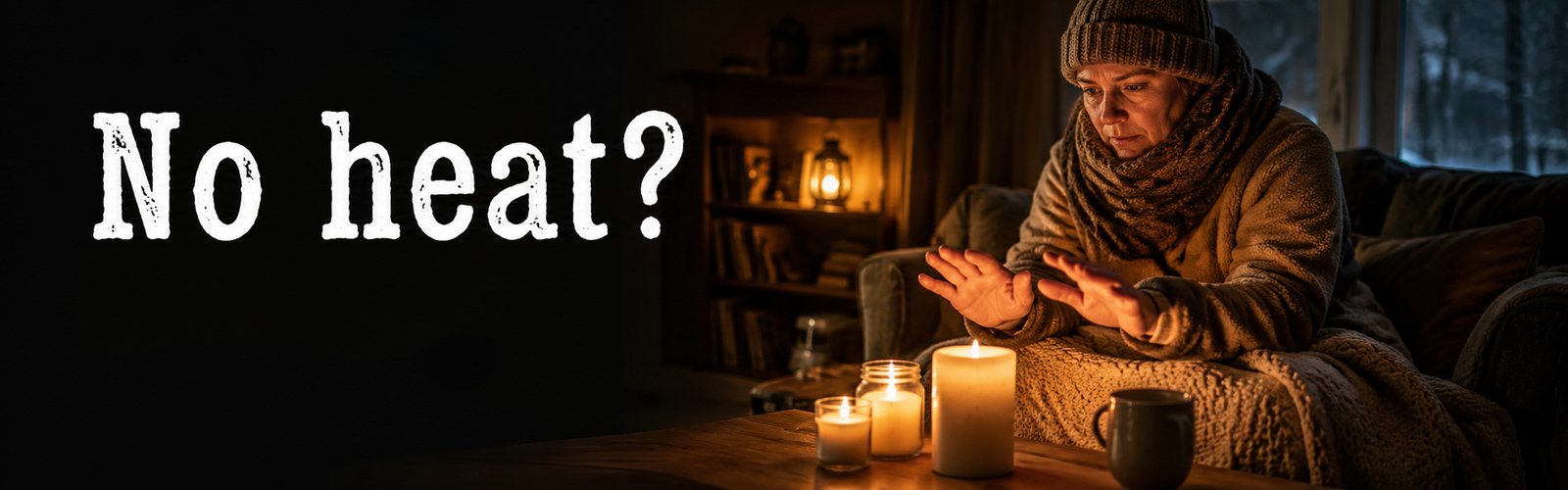
It’s cold outside.
Then suddenly you realize the furnace hasn’t come on.
The temperature inside the house is beginning to drop.
Before assuming you have a major heating-system failure, check the simple things first. And if the heat really is out, knowing what to do next can keep a miserable situation from becoming a dangerous one.
Cold-weather emergencies are especially serious because the house doesn’t become dangerously cold all at once.
It happens gradually.
That can give you time to act—if you don’t wait too long.
First, Check the Simple Things
Before calling a repair person, do a few basic checks.
Check the thermostat
Make sure:
- It is set to HEAT
- The temperature setting is above the current room temperature
- The batteries aren’t dead, if your thermostat uses them
Someone may have changed the setting without realizing it.
Check the circuit breaker
Look at the electrical panel for a tripped breaker associated with the furnace or heating system.
If a breaker has tripped, you can reset it once.
If it immediately trips again, don’t keep resetting it. Something may be wrong that requires professional attention.
Check the furnace switch
Many furnaces have a regular-looking wall switch nearby.
It can accidentally get turned off.
Make sure it’s on.
Check your fuel
If you use propane, heating oil or another delivered fuel, make sure you haven’t simply run out.
Check obvious vents and filters
A severely clogged furnace filter can cause some systems to shut down or operate poorly.
Make sure vents haven’t been accidentally blocked as well.
Don’t take apart the furnace or start bypassing safety controls.
We’re checking the easy things—not becoming furnace technicians.
If the Heat Really Is Out, Start Conserving Heat
Once you’ve determined that this isn’t a simple thermostat problem, stop thinking about heating the entire house.
Think about keeping people warm.
Choose one or two rooms where everyone can stay together.
Close doors to rooms you don’t need.
Close curtains and blinds at night.
If cold air is coming underneath a door, roll up a towel and place it along the bottom.
If you have drafty windows, curtains, blankets or other temporary coverings can help reduce heat loss.
During sunny daytime hours, open curtains on windows receiving direct sunlight and let the sun help warm the room.
Then close them again as temperatures fall.
Dress for the Temperature—Even Inside
Don’t wait until you’re shivering to put on warmer clothes.
Dress in layers.
Wear:
- A warm shirt or sweater
- Loose layers
- Warm pants
- Thick socks
- Slippers or shoes
- A hat
Yes, a hat in the house.
You aren’t trying to win a fashion contest.
You’re trying to stay warm.
Add blankets while you’re sitting or sleeping.
If several people are in the house, staying together in one room also helps because your bodies produce heat.
Make the Space Smaller
Here’s another bit of old-fashioned common sense.
If you can’t warm a large space, make the space you’re trying to warm smaller.
Close doors.
Hang a blanket across an open doorway if necessary.
Families have even made temporary sleeping areas using blankets to create a smaller space around a bed or sitting area.
You aren’t trying to create an airtight enclosure—fresh air still matters.
You’re simply reducing the amount of space where you need to retain warmth.
Be Extremely Careful With Alternative Heat
This is where a heating emergency can become much more dangerous than the cold itself.
People get desperate and begin using things for heat that were never designed to heat a house.
Never use a charcoal grill indoors.
Never bring an outdoor gas grill inside.
Never use a generator inside the house, garage, basement, porch or other enclosed or partly enclosed area.
Never use a vehicle running in a garage to produce heat.
These can produce carbon monoxide—a gas you cannot see or smell that can kill you.
Don’t use your kitchen oven or gas range as a substitute for home heating either.
Portable heaters should only be used according to the manufacturer’s instructions and should be kept well away from curtains, bedding, furniture and anything else that can burn.
Carbon Monoxide Detectors Matter
Every home with fuel-burning appliances, a fireplace, or an attached garage should have working carbon-monoxide detectors.
And a cold-weather emergency is not the time to discover that the detector hasn’t had a working battery in three years.
Test your detectors regularly.
If a carbon-monoxide alarm sounds, get everyone outside into fresh air and contact emergency services.
Do not assume the alarm is malfunctioning.
Don’t Forget the Water Pipes
If the house gets cold enough, plumbing can freeze.
Pipes along exterior walls, in crawlspaces, basements and other poorly insulated areas may be particularly vulnerable.
You can help by opening cabinet doors beneath sinks so warmer room air can circulate around the plumbing.
During severe cold, allowing a small trickle of water through vulnerable pipes may sometimes help reduce freezing risk, although the best approach depends on your plumbing and local conditions.
Most importantly:
Know where your main water shutoff valve is.
If a pipe freezes and bursts, shutting off the water quickly can prevent enormous damage.
Everyone capable of doing so in the household should know where that valve is and how to operate it.
What About the Refrigerator and Freezer?
If the heating failure is part of a power outage, keep refrigerator and freezer doors closed as much as possible.
Every time you open them, cold air escapes.
Don’t repeatedly check the food.
If it’s cold enough outside, don’t automatically put food outdoors. Temperatures fluctuate, sunlight can warm food, and animals can get into it.
A cooler placed in an appropriately cold protected location may be a better option if the outage lasts long enough to require moving food.
If You Depend on Medical Equipment
A heating emergency becomes more serious when someone in the household depends on electrically powered medical equipment.
Don’t wait until backup batteries are almost exhausted before making a plan.
Know ahead of time:
- How long backup power will last
- Whether the equipment has an approved alternate power source
- Who to contact if power is lost
- Where you can go if electricity isn’t restored
If someone’s health depends on the equipment, leaving early may be far safer than waiting to see what happens.
Watch Older Adults and Small Children Carefully
Some people are more vulnerable to cold than others.
Older adults, babies, young children and people with certain medical conditions may have difficulty maintaining body temperature.
Don’t judge safety only by how cold you feel.
Watch everyone in the household.
Warning signs of hypothermia can include:
- Persistent or intense shivering
- Unusual tiredness
- Confusion
- Slurred speech
- Poor coordination
- Drowsiness
In babies, warning signs can include unusually low energy and skin that feels cold.
If you suspect hypothermia, seek medical help promptly.
Know When It’s Time to Leave
There comes a point when staying in the house isn’t frugal, independent or brave.
It’s simply unsafe.
If the indoor temperature continues dropping and you have no safe way to maintain warmth, go somewhere warm while you still can.
That might be:
- A family member’s home
- A neighbor’s home
- A church
- A community warming center
- A hotel
- Another safe heated location
This is particularly important when severe weather may make roads worse later.
If you know the house is becoming unsafe and you have a safe opportunity to leave, don’t wait until the roads become impassable.
Prepare While the Heat Is Working
The best time to prepare for losing heat is while you’re sitting comfortably in a warm house.
Have a basic cold-weather plan.
Know:
- Where the water shutoff is
- Where the electrical panel is
- How your heating system normally operates
- Who repairs your heating system
- Where you could go if the house became too cold
- How you would get there
Keep useful supplies where you can find them:
- Flashlights
- Extra batteries
- Warm blankets
- Hats and gloves
- Drinking water
- Easy-to-prepare food
- Necessary medications
- Charged power banks
- A battery-powered radio if you have one
And keep working smoke and carbon-monoxide detectors in the house.
None of this needs to become an expensive survival project.
It’s simply preparation for something that really does happen.
Mountain Heart Ministries
Hope for Today • Help for Tomorrow • Faith for the Journey
Helping our Appalachian neighbors one life, one family,
and one community at a time.
Contact
info@mountainheartministries.org
Serving mountain communities in Eastern Kentucky
and Northeast Tennessee.
“My little children, let us not love in word, neither in tongue;
but in deed and in truth.”
1 John 3:18 (KJV)
© 2026 Mountain Heart Ministries. All Rights Reserved.
Mountain Heart Ministries is a Christian nonprofit organization
dedicated to serving individuals and families with compassion,
dignity, and hope.