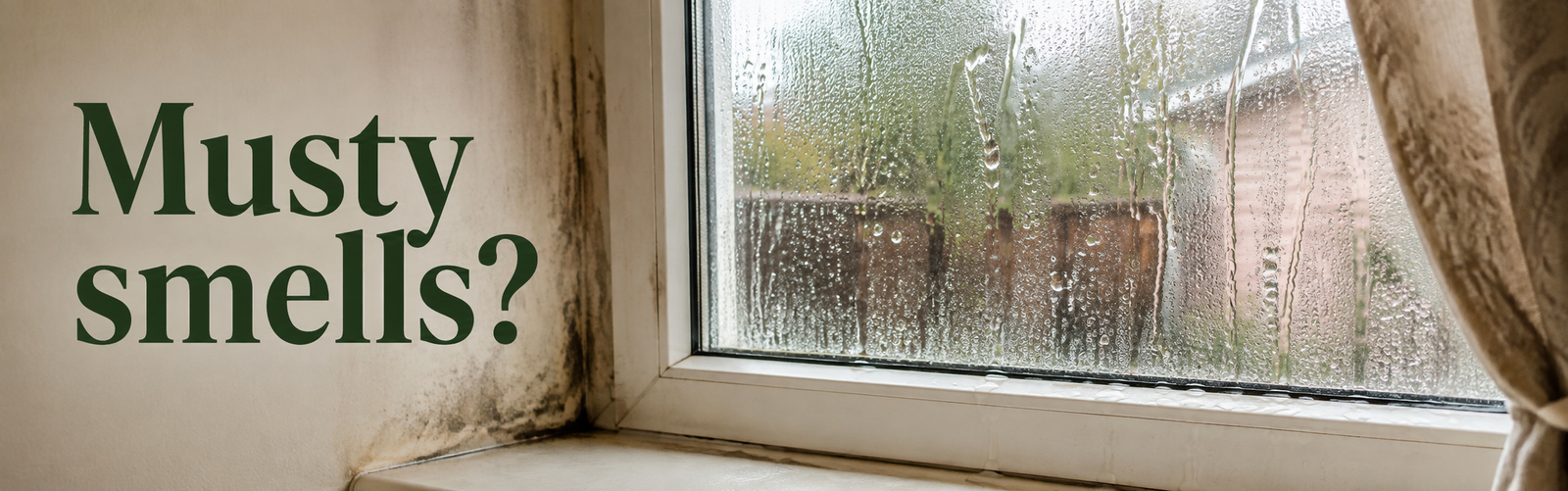
You walk into a room and smell it immediately.
That stale, damp, musty smell.
The first temptation may be to spray some air freshener, light a candle or plug in something that makes the room smell like vanilla.
But that doesn’t solve anything.
A musty smell is usually telling you something.
Instead of covering it up, find out where it’s coming from. Often, the solution costs very little—or nothing at all.
First, Find the Source
Before cleaning the entire house, try to narrow down where the odor is strongest.
Walk around and smell.
Yes, really.
Check:
- Closets
- Cabinets under sinks
- Bathrooms
- Laundry rooms
- Basements and crawlspace entrances
- Around windows
- Behind furniture
- Rugs and carpeting
- Upholstered furniture
- Mattresses and bedding
- Towels and laundry
- Shoes and coats
- Garbage cans
- Refrigerator drip pans or forgotten food
- Areas where you’ve had a leak in the past
If the smell is stronger in one particular place, start there.
Don’t clean everything when one damp towel in the bottom of a hamper may be the culprit.
Look for Moisture
Musty smells and moisture frequently go together.
Look for obvious problems such as a dripping pipe, condensation around a window, damp carpet, a leaking appliance or water underneath a sink.
But also look for less obvious moisture.
Move things.
Look behind the box that’s been sitting against the basement wall for six months.
Check underneath the bathroom rug.
Feel the back of furniture pushed against a cool exterior wall.
Look underneath stored items.
If you find moisture, finding out why it’s wet is more important than making it smell better.
Open the House Up
Sometimes a house simply needs fresh air.
When weather permits, open windows and doors and let air move through the house.
Open closet and cabinet doors too.
A fan can help move stale air out and fresh air in.
Rooms that stay closed for long periods can develop that old, stale smell even when there isn’t a serious moisture problem.
Fresh air is free.
Use it.
Let the Sunshine Help
Sunlight is one of those old-fashioned household helpers we’ve nearly forgotten.
If something smells stale or musty and can safely be placed outside, give it some fresh air and sunshine.
Depending on the material, this can be useful for things such as:
- Washable rugs
- Blankets
- Pillows
- Some cushions
- Shoes
- Baskets
- Fabric items
Make sure everything is completely dry before bringing it back inside.
Don’t leave delicate fabrics, photographs, wood finishes or other sun-sensitive items outdoors long enough to damage or fade them.
The point is fresh air and drying—not baking everything you own in the backyard.
Check the Towels
Sometimes the mysterious musty smell isn’t mysterious at all.
It’s the towels.
A towel that stays damp too long can develop an odor that returns as soon as it gets wet again.
Wash musty towels thoroughly and dry them completely.
And don’t leave wet towels piled in a hamper.
Hang them where they can dry first.
The same applies to washcloths, dishcloths and cleaning rags.
A damp cleaning rag shoved underneath the kitchen sink can make an entire cabinet smell awful.
Don’t Put Things Away Damp
This is one of the simplest ways to prevent musty smells.
Dry things before storing them.
That includes:
- Towels
- Clothes
- Shoes
- Outdoor cushions
- Cleaning cloths
- Mops
- Umbrellas
- Camping equipment
- Seasonal decorations stored in damp areas
If something goes into a closed container while damp, you’ve created a nice little environment for odors—and possibly mold—to develop.
Let it dry first.
Check Your Closets
Closets don’t get much airflow, particularly when they’re packed tightly.
If a closet smells musty, take some things out.
Look at the walls and floor.
Check shoes and clothing.
Make sure nothing is damp.
Leave the door open for a while and allow air to circulate.
If clothing is packed from wall to wall, consider giving things a little breathing room.
And here’s another good reason not to keep things you haven’t worn since 1987.
Sometimes less stuff means better airflow.
Baking Soda Can Help With Odors
Plain baking soda can be useful for absorbing some household odors.
You can place an open container in an appropriate location such as a refrigerator, cabinet or other dry enclosed area.
It can also be useful on some carpets and upholstered surfaces, provided the material can safely be vacuumed afterward.
But remember:
Baking soda can help with the smell. It doesn’t fix the moisture problem causing the smell.
If the odor keeps returning, keep looking.
Be Careful With Vinegar—and Cleaning Products in General
Diluted white vinegar can be useful for some household cleaning jobs and odors, but it isn’t appropriate for every surface.
Acidic cleaners can damage materials such as some natural stone surfaces.
And never start combining household cleaners because somebody on the Internet said it makes them “work better.”
Never mix bleach with vinegar, ammonia or other cleaners. Dangerous gases can result.
Use cleaning products according to their labels.
Common sense belongs in the cleaning cabinet too.
Check Upholstered Furniture
An old chair or sofa can hold odors for years.
First, vacuum it thoroughly—including underneath cushions.
Check for evidence that something has been spilled.
If the fabric can be safely cleaned, follow the manufacturer’s cleaning instructions.
Sometimes simply moving the furniture away from the wall and allowing air to circulate around it helps.
If furniture has been wet from flooding or a serious leak, however, that’s a different matter. Moisture can get deep into padding where surface cleaning won’t solve the problem.
Check Rugs and Carpeting
Carpet can hide all kinds of surprises.
If one area smells musty, feel it.
Is it damp?
Has something spilled there?
Is it near a window, door, bathroom or appliance that may have leaked?
If possible, check underneath the rug or carpet.
Cleaning the top won’t solve a moisture problem underneath.
Again, find the cause first.
Don’t Forget the Mattress
Mattresses absorb moisture from the people sleeping on them and from the surrounding air.
When changing the bedding, occasionally leave the mattress uncovered for a while rather than immediately putting fresh sheets back on.
Allow air to circulate.
If possible, pull the bed slightly away from the wall and check underneath it.
A mattress sitting in a damp room may be telling you more about the room than about the mattress.
Basements Need Air Movement
Basements are naturally prone to moisture because they’re cooler and partly or completely below ground.
If yours smells musty, don’t automatically reach for air freshener.
Look for:
- Water seepage
- Damp walls
- Condensation
- Plumbing leaks
- Wet cardboard boxes
- Damp carpeting
- Poor airflow
Cardboard is particularly good at absorbing moisture and odors.
If you’re storing important belongings in a basement that tends to be damp, plastic storage containers may make more sense than cardboard boxes.
A dehumidifier can also help when humidity is consistently high, but if water is actually entering the basement, the source of that water still needs to be addressed.
Check Under the Sinks
This is an easy one to miss.
Take everything out from underneath the kitchen and bathroom sinks occasionally.
Then look.
A tiny plumbing leak may have been dripping for months without being obvious.
Feel the bottom of the cabinet.
Look for staining, swelling or dampness.
And smell.
If you find a leak, repair the leak before worrying about the odor.
Otherwise, the smell will simply return.
What If You Find Mold?
A little surface mildew caused by ordinary dampness may sometimes be manageable with appropriate cleaning and moisture control.
But widespread mold, repeated mold growth, significant water damage or mold associated with sewage or flooding is another matter.
Don’t simply spray something over it and assume the problem is solved.
The moisture source has to be corrected, and larger or complicated mold problems may require professional assessment and cleanup.
People with asthma, allergies, chronic lung conditions or weakened immune systems may also need to be especially cautious around mold.
Don’t Try to Perfume a Problem Away
Air fresheners, scented candles and sprays have their place if you simply enjoy the fragrance.
But they shouldn’t be your solution to a persistent musty odor.
Think about what happens when you spray floral air freshener into a damp, musty room.
Now you have:
Damp musty flowers.
You haven’t fixed anything.
If an odor keeps coming back, something is causing it.
Find that something.
A Simple Musty-Smell Checklist
When you notice a musty odor, work through the problem in this order:
- Find where the smell is strongest.
- Look for moisture or a leak.
- Remove anything wet or damp.
- Clean the affected area appropriately.
- Dry everything completely.
- Increase ventilation and airflow.
- Watch to see whether the smell returns.
If it does return, don’t keep treating the smell.
Keep looking for the cause.
Mountain Know-How
Mountain Heart Ministries
Hope for Today • Help for Tomorrow • Faith for the Journey
Helping our Appalachian neighbors one life, one family,
and one community at a time.
Contact
info@mountainheartministries.org
Serving mountain communities in Eastern Kentucky
and Northeast Tennessee.
“My little children, let us not love in word, neither in tongue;
but in deed and in truth.”
1 John 3:18 (KJV)
© 2026 Mountain Heart Ministries. All Rights Reserved.
Mountain Heart Ministries is a Christian nonprofit organization
dedicated to serving individuals and families with compassion,
dignity, and hope.