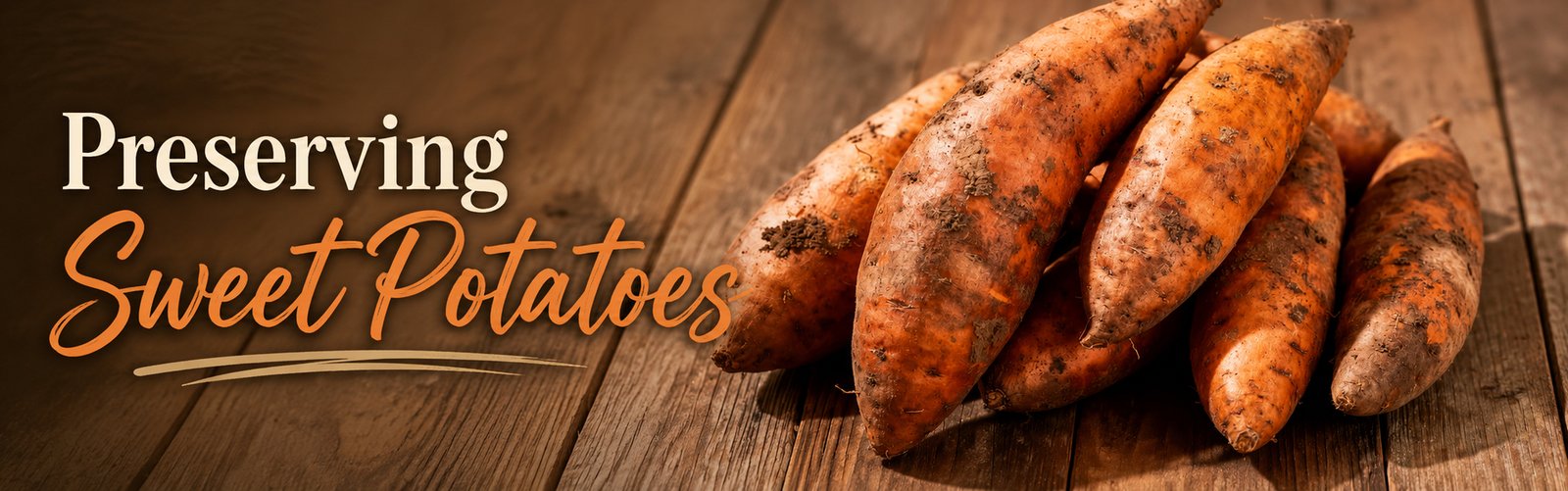
How to Preserve and Store Sweet Potatoes for Winter
Growing sweet potatoes is only half the job.
If you’ve spent the summer watching those vines spread across the garden, the real payoff comes when you can put the harvest away and continue eating it for months.
Sweet potatoes can store remarkably well, but there’s an important step between digging them and putting them away for winter:
They need to be cured.
Curing helps small cuts and scrapes heal, toughens the skin for storage, and allows the sweet potatoes to develop more of the sweetness we expect when we cook them.
And you don’t need an expensive setup to do it.
When to Harvest Sweet Potatoes
Sweet potatoes are usually harvested in the fall before cold weather damages the roots.
Don’t wait for a hard freeze.
The vines may begin yellowing as the season winds down, but you can also carefully dig around one plant to see how the potatoes have developed.
When you’re ready to harvest, cut back some of the vines so you can see what you’re doing.
Then dig carefully.
Sweet potatoes can spread farther from the center of the plant than you might expect, so begin digging well away from the main stem.
A garden fork can work well, but don’t plunge it directly beside the plant. It’s surprisingly easy to spear a perfectly good sweet potato.
Loosen the soil first and then lift the potatoes gently.
Handle Them Carefully
Freshly dug sweet potatoes have tender skins.
They can be scraped or bruised much more easily than the potatoes you buy at the grocery store.
Don’t toss them into a bucket.
Don’t scrub them.
And don’t worry about making them pretty yet.
Gently remove large clumps of loose dirt with your hands and leave the rest alone.
Do not wash sweet potatoes before curing or storing them.
Extra moisture can encourage spoilage.
Wash them when you’re ready to cook them instead.
Sort the Harvest
Before curing, look over what you’ve dug.
Set aside potatoes that are:
- Cut by the shovel or fork
- Badly bruised
- Split
- Soft
- Damaged by insects or animals
- Showing signs of rot
A small scrape may heal during curing, but badly damaged potatoes shouldn’t go into long-term storage with the rest.
That doesn’t necessarily mean they’re wasted.
If they’re otherwise sound, trim away the damaged portion and use them first.
Save your best, healthiest sweet potatoes for long-term storage.
What Does “Curing” Mean?
Curing isn’t complicated.
It’s simply holding freshly harvested sweet potatoes in warm, humid conditions for several days before moving them into storage.
Under ideal commercial conditions, sweet potatoes are commonly cured at roughly 80–85°F with high humidity for about a week.
Most of us don’t have a commercial curing room sitting behind the house.
Fortunately, home gardeners can work with what they have.
The important things are:
Warmth + humidity + some air circulation.
Curing helps toughen the skin and heal minor harvest injuries.
It also begins the process that improves the potatoes’ flavor.
That’s why a sweet potato dug yesterday may not taste nearly as sweet as one that has been properly cured and stored for a little while.
How to Cure Sweet Potatoes at Home
Look for the warmest suitable place you already have.
Depending on the weather and your home, possibilities might include:
- A warm utility room
- A warm enclosed porch
- A small room with controlled warmth
- Another protected area where temperatures remain warm
Spread the sweet potatoes out rather than piling them deeply on top of one another.
Cardboard boxes, shallow crates, or other containers that allow some airflow can work.
The goal isn’t perfection.
You’re trying to provide a warm, humid environment for roughly 7–10 days without letting the potatoes become wet or allowing condensation to collect on them.
If you cannot maintain ideal curing temperatures, give them the warmest reasonable conditions you can for a little longer.
Keep checking them.
If a potato begins to soften or rot, remove it.
Don’t Put Them in the Refrigerator
This one surprises people.
Sweet potatoes like warmth when curing and relatively moderate temperatures when stored.
They do not like refrigerator temperatures.
Temperatures that are too cold can damage sweet potatoes and affect their texture and flavor when cooked.
After curing, aim for a storage area that stays roughly 55–60°F, if possible.
A cool basement, pantry, cellar, or other dark area may work depending on your house.
But don’t assume a garage or outdoor building is safe.
If it freezes in winter, it’s too cold.
Darkness Matters
Store cured sweet potatoes somewhere dark.
Light isn’t helpful during long-term storage, and a dark location also tends to provide more stable conditions.
Good storage choices might include:
- Cardboard boxes
- Wooden crates
- Baskets
- Ventilated containers
Avoid sealing sweet potatoes tightly in plastic bags where moisture can become trapped.
They need some air circulation.
Newspaper Can Be Useful
An old-fashioned method is to loosely wrap individual cured sweet potatoes in newspaper before placing them in a box or basket.
You don’t have to do this, but it can help keep potatoes separated and may make it easier to remove one that begins to spoil before it affects its neighbors.
You can also place layers of newspaper between rows.
Don’t pack the container so tightly that there’s no airflow.
And don’t make the box so heavy that you have to hire somebody to move it.
Several smaller boxes are often more practical than one enormous one.
Check Them During the Winter
Putting food into storage doesn’t mean forgetting about it until February.
Every couple of weeks, take a quick look.
Watch for potatoes that are:
- Softening
- Shriveling badly
- Developing wet spots
- Growing mold
- Beginning to rot
Remove questionable potatoes promptly.
One rotten potato sitting unnoticed in a box can cause trouble for the potatoes around it.
This is one of those five-minute jobs that can save a substantial amount of food.
How Long Will Sweet Potatoes Keep?
Under good conditions, properly cured sweet potatoes can often remain usable for several months.
Exactly how long depends on the variety, how carefully they were harvested, how well they cured, and the conditions where they’re stored.
That’s why curing and storage matter so much.
If you harvest 40 pounds of sweet potatoes but half of them rot within a month, you didn’t really grow 40 pounds of usable food.
Preserving the harvest is part of growing the harvest.
Use the Imperfect Ones First
You don’t have to eat your prettiest sweet potatoes first.
Do the opposite.
When choosing potatoes for dinner, use the smaller, oddly shaped, lightly damaged, or less-than-perfect ones first.
Leave the best storage potatoes alone.
It’s the same principle people once used with apples, potatoes, onions and other stored crops:
Eat the ones least likely to keep. Save the best keepers for later.
Simple, but effective.
Save Some for Next Year’s Garden
Here’s where sweet potatoes become particularly valuable for a family trying to stretch the food budget.
You don’t necessarily have to buy new plants every spring.
Choose several healthy, undamaged sweet potatoes from your harvest and store them carefully.
Those potatoes can potentially be used to produce slips for next year’s garden.
One year’s crop can help start the next.
Think about that.
You buy or obtain sweet potato slips once.
You grow a crop.
You eat from that crop through fall and winter.
You save a few good potatoes.
Those potatoes produce slips.
The slips grow another crop.
And the cycle begins again.
From One Harvest to the Next
There was a time when knowing how to store food wasn’t a hobby.
It was simply part of feeding a family.
People didn’t grow a garden just to have fresh vegetables in July.
They canned.
They dried.
They stored.
They saved seed.
And they planned for February while they were harvesting in September.
That’s the part of gardening we sometimes forget.
Growing food is valuable.
Mountain Heart Ministries
Hope for Today • Help for Tomorrow • Faith for the Journey
Helping our Appalachian neighbors one life, one family,
and one community at a time.
Contact
info@mountainheartministries.org
Serving mountain communities in Eastern Kentucky
and Northeast Tennessee.
“My little children, let us not love in word, neither in tongue;
but in deed and in truth.”
1 John 3:18 (KJV)
© 2026 Mountain Heart Ministries. All Rights Reserved.
Mountain Heart Ministries is a Christian nonprofit organization
dedicated to serving individuals and families with compassion,
dignity, and hope.